
ABOUT ARMANIX
Engineering difficult systems into real products.
Armanix Consulting is an engineering and technology company focused on robotics, intelligent systems, and technically ambitious product development.
PRODUCT DEVELOPMENT + ENGINEERING DEPTH
Built on experience developing systems that have to work.
Armanix was founded on more than two decades of building safety-critical complex robotic systems where performance, reliability, safety, and rigorous verification are fundamental to the development process.
That experience shapes how Armanix approaches engineering: understand the system, identify the risks, build deliberately, test continuously, and create an architecture capable of surviving the transition from prototype to product.
This product-development foundation is complemented by a deep academic and research background in robotics, controls, computer vision, and intelligent systems.

FOUNDER
Azad Shademan
Founder & Principal Engineer
Product development grounded in engineering rigor.
I’m Azad Shademan, PhD, founder of Armanix Consulting. I bring more than two decades of experience developing advanced robotic systems, spanning robotics controls, haptics, teleoperation, sensing, automation, and real-time software.
Before founding Armanix, I spent more than a decade at Intuitive developing technologies for surgical robotics. I led cross-functional development of Intuitive’s latest autonomous function from early concept through verification, regulatory clearance, and commercial launch, and previously served as lead architect for Haptics and Interaction Controls Engineering for the da Vinci 5 surgical system.
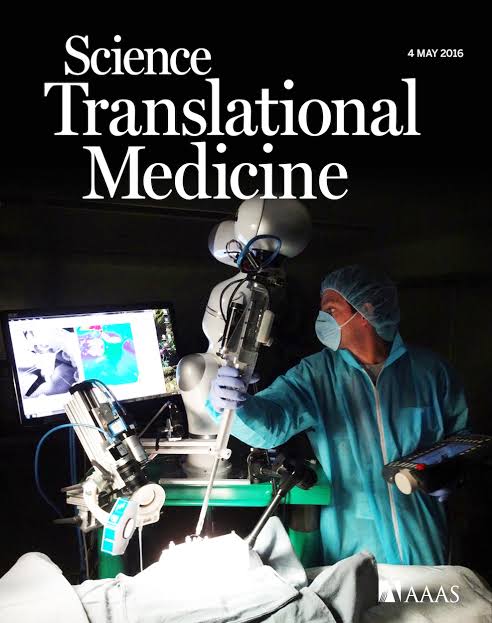
My earlier research focused on autonomous surgery, including development of the Smart Tissue Autonomous Robot (STAR) for autonomous soft-tissue surgery. My work has been published in Science Translational Medicine, cited more than 3,800 times, and contributed to 20+ patents and patent applications.
At Armanix, I apply that experience to robotics and physical-AI problems where strong system architecture, real-time performance, safety, and rigorous verification matter.
READ MORE ABOUT AZAD →
01 — COMMERCIAL ROBOTIC SYSTEMS
Building Commercial Robotic Systems
At Intuitive, I worked across the lifecycle of safety-critical robotic products—from early architecture and requirements through implementation, verification, regulatory clearance, and commercial deployment.
Most recently, I served as the Directly Responsible Individual (DRI) and core team lead for Intuitive’s first supervised-autonomous function, surgeon-initiated tool eject. I led the cross-functional effort from early concept and project initiation through system development, verification and validation, 510(k) clearance, and launch in the United States and Europe.
Previously, I was the lead architect for Haptics and Interaction Controls Engineering for the da Vinci 5 multiport surgical system. My work included next-generation interaction technologies, real-time motion-control software, system requirements and specifications, and verification and validation.
I also served as hazard analysis lead for motion-controls software and as a Design Review Board member for imaging and intelligence products. Alongside traditional engineering workflows, I developed AI-driven methods for analyzing system logs and investigating complex system behavior.
02 — AUTONOMOUS ROBOTICS
Research in Autonomous Robotics
My work in autonomous robotics began before commercial surgical systems. I developed the Smart Tissue Autonomous Robot (STAR), using KUKA lightweight 7-DOF robotic arms to investigate autonomous soft-tissue surgery, including autonomous bowel anastomosis.
That research was published in Science Translational Medicine and has been cited more than 3,800 times.
Earlier, I developed controls and computer-vision software for visual servoing of 7-DOF Barrett WAM robotic manipulators.
Across research and industry, my work has contributed to 20+ patents and patent applications, including more than ten granted patents. I was also recognized as Inventor of the Year for contributions to robotics innovation.
03 — ENGINEERING PHILOSOPHY
Engineering for the Real World
Armanix brings the discipline of safety-critical product development to robotics, physical AI, and complex engineering problems.
My approach starts with the system rather than a technology in isolation: understanding requirements, interfaces, failure modes, performance constraints, and verification strategy before committing to an architecture.
My core areas of expertise include real-time robotic controls, haptics and interaction systems, sensing and sensor integration, teleoperation, system architecture, requirements and specifications, hazard and risk analysis, DFMEA, verification and validation, and technical leadership across multidisciplinary teams.
The same principles used to develop safety-critical medical robotic systems—measurable requirements, deterministic behavior where it matters, thoughtful failure handling, rigorous testing, and evidence-based engineering decisions—form the engineering foundation of Armanix Consulting.
20+ years
ENGINEERING & ROBOTICS
10+ years
NEW PRODUCT DEVELOPMENT
PhD
Robotics & Computer Vision
20+
PATENTS / INVENTIONS
SELECTED EXPERIENCE — PRIOR TO ARMANIX
Engineering experience behind Armanix.
Before founding Armanix, Azad Shademan spent more than a decade developing advanced surgical robotic systems at Intuitive, spanning autonomous motion, interaction controls, edge computing, safety-critical hardware, verification, and regulated product development.

01 — AUTONOMOUS & SAFETY-CRITICAL ROBOTIC SYSTEMS
Led architecture and safety engineering for autonomous robotic motion.
Served as Directly Responsible Individual (DRI) and lead architect for surgeon-initiated tool eject, including leading hazard analysis and mitigations for autonomous motion of surgical instruments within the patient for soft-tissue surgery.
Inventor on three pending patent applications covering robotics control technologies.

02 — HUMAN-CENTERED ROBOTICS & OPERATIONAL EFFICIENCY
Architected surgeon-autonomy capabilities for da Vinci 5.
Led architecture and development of key da Vinci 5 capabilities that enable surgeons to directly manage robotic system functions from the surgeon console, reducing dependence on OR staff for routine interactions.
Work included head-in interaction controls and digital instrument swap/eject—capabilities supporting greater surgeon autonomy and OR efficiency.

03 — EDGE COMPUTING, TELEMETRY & AI INFRASTRUCTURE
Built edge-compute and multimodal data infrastructure for robotic AI.
Developed Intuitive’s first edge-compute node within the Imaging & Intelligence organization and architected infrastructure for synchronized kinematics and vision data logging, enabling robotic system data to be integrated into downstream AI models.
The work connected real-time robotic systems, observability, multimodal data infrastructure, and machine-learning development.

04 — SAFETY, VERIFICATION & REGULATED PRODUCT DEVELOPMENT
Developed verification infrastructure for safety-critical robotic hardware.
Designed qualification and verification processes for electric motors and magnetic encoders used in safety-critical robotic systems, and developed software for detecting and reporting sensor-based safety violations.
Served on the Design Review Board for Intuitive’s Imaging & Intelligence product portfolio, providing technical review within a regulated medical-device development environment.
AWARDS, PUBLICATIONS & PATENTS
Research, invention, and recognition.
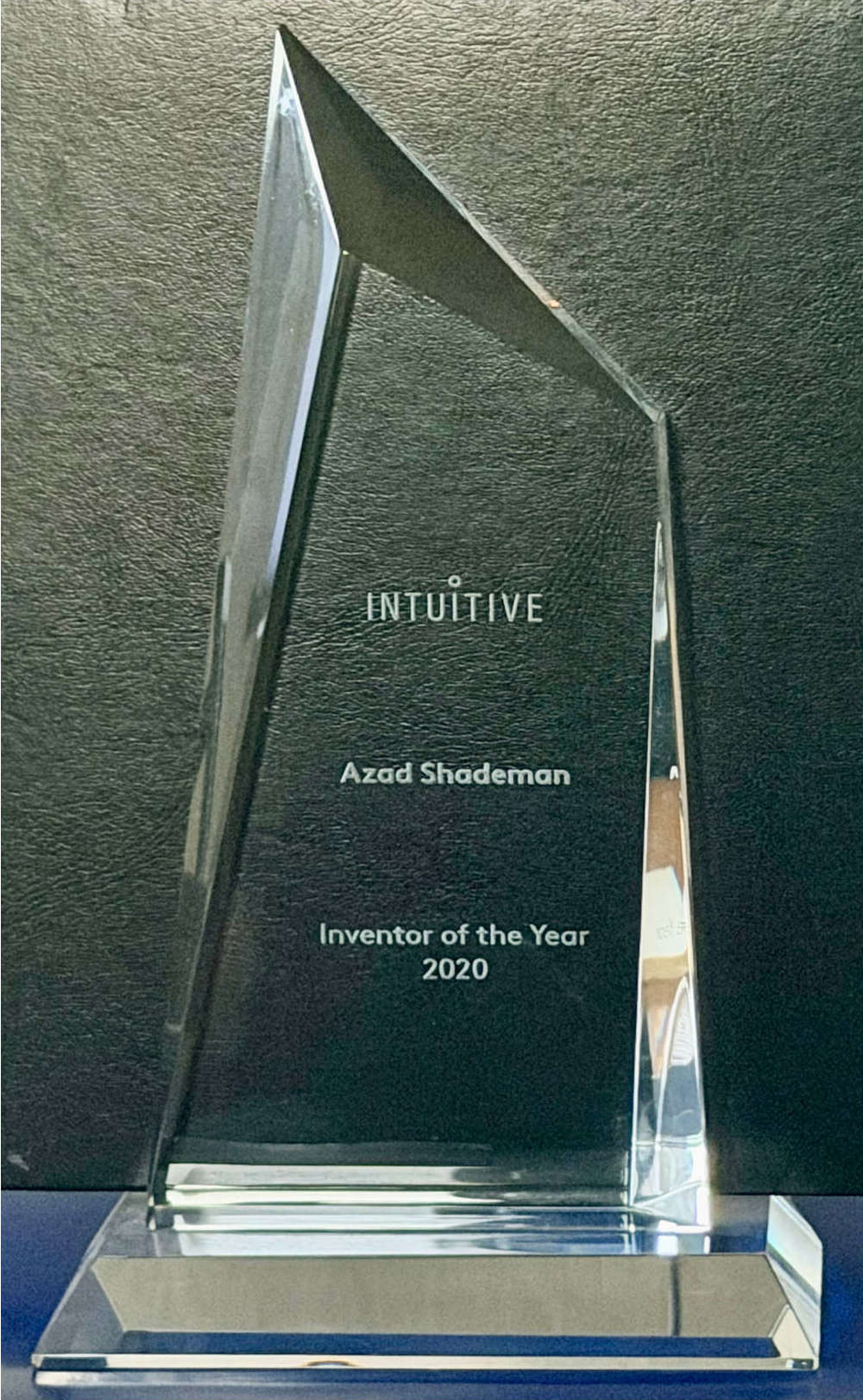
2020 Inventor of the Year
Recognized for contributions to robotics innovation, spanning intelligent robotic interaction, autonomous systems, and engineering research.
20+ patents and patent applications across autonomy, controls, sensing, computer vision, and human–machine interaction.
3,800+ academic citations reflecting the impact of research in robotics and autonomous surgery.
Selected Patents — Intuitive Surgical (2016–2026)
- Systems and Methods for Identifying and Facilitating an Intended Interaction — US Patent 12,551,298 (2026). Intent recognition and automated robotic interaction.
- Systems and Methods for Facilitating Automated Operation of a Device — US Patent Application 2023/0126545 (2023). Automated robotic operation based on instrument and environmental characteristics.
- Systems and Methods for Optimizing Configurations of a Computer-Assisted System — WO2021194903A1 (2021). Robotic configuration optimization and reachability analysis.
- Force-Based Control of a Virtual Object Displayed by a Computer-Assisted System — DE112022006114T5 (2024). Force-based interaction control and virtual object manipulation.
- Physical Medical Element Placement Systems — US Patent 12,207,884 (2025). Autonomous mesh suturing and hernia repair.
Selected Patents — Earlier Robotics Research
- Automated Surgical and Interventional Procedures — US Patent 9,220,570 (2015). Autonomous robotic operation.
- Method and System for Providing Recommendation for Optimal Execution of Surgical Procedures — US Patent 10,244,991 (2019). Intelligent planning and procedural optimization.
- 3D Corrected Imaging — US Patent 10,089,737 (2018). Three-dimensional perception and image correction.
Selected Peer-Reviewed Publications
- Shademan, A., et al. (2016). Supervised autonomous robotic soft tissue surgery. Science Translational Medicine, 8(337), 337ra64.
- Shademan, A., Farahmand, A. M., & Jägersand, M. (2010). Robust Jacobian estimation for uncalibrated visual servoing. IEEE International Conference on Robotics and Automation (ICRA), 5564–5569.
CORE EXPERTISE
Product engineering for systems that have to work.
New Product Development
Moving technology from technical feasibility through architecture, implementation, integration, testing, and product maturity.
Safety-Critical Systems
Designing systems with explicit requirements, risk controls, failure behavior, and safety considerations incorporated into the architecture.
Test-Driven Development
Building testability into development—from unit and subsystem testing through system-level verification and validation.
Robotics & Physical AI
Controls, sensing, manipulation, real-time systems, autonomy, and integration of intelligent components with physical systems.
System Architecture
Defining boundaries and interfaces across software, controls, sensing, hardware, simulation, and intelligent components.
Verification & Validation
Requirements traceability, system integration, test strategy, risk analysis, and rigorous verification across complex robotic systems.
ENGINEERING PHILOSOPHY
Innovation has to survive contact with the real world.
Start with requirements.
Define what the system must do, under what conditions, and how success will be measured.
Design for verification.
Testability belongs in the requirements and architecture from the beginning—not at the end of development.
Build and test early.
Working prototypes expose assumptions, characterize performance, and reduce technical risk.
Design for fault tolerance.
Real products encounter sensor faults, communication failures, timing problems, hardware limitations, and unexpected inputs.
Use AI deliberately.
AI creates powerful capabilities, but not every part of a system should become probabilistic. Intelligent components should have clear interfaces with the deterministic parts of the system.
Engineer for maintainability.
Build clear interfaces, observability, and practical diagnostics so systems can be supported and improved after deployment.
WHY ARMANIX
Research depth. Product discipline.
Armanix brings together two engineering perspectives that are often separated: advanced research exploring what is technically possible, and the discipline required to develop sophisticated technology into testable, reliable, maintainable real-world products.
Armanix applies both perspectives to new products and difficult engineering problems.
Let’s build something difficult.
Whether you’re developing a new robotic system, integrating AI into an existing product, investigating a new architecture, or trying to move promising technology beyond the prototype stage, start with the engineering problem.